
The International Quilt Study Center located in Lincoln, NE and Baltimore on the Prairie have developed a wonderful working relationship. As taken from their web site: "The International Quilt Study Center & Museum's mission is to inspire an understanding of the cultural and artistic significance of quilts by collecting, preserving, studying, exhibiting and promoting discovery of quilts and quiltmaking traditions from many cultures, countries and times." There are always at least 2 exhibitions, sometimes 3, in the galleries with other quilts adorning the walls and hallways on the 3rd floor. Lately some of those quilts are from the Hortense Beck collection and the library has exhibits of doll beds, quilts, etc from the Mary Ghormley collection. One of the current exhibitions is titled "Perfecting the Past - Colonial Revival Quilts".

As one enters the gallery, "The Quilting Party" greets you. It's a beautiful oil painting by Edgar Melville Ward, circa 1892 depicting the Colonial Revival mindset of people in the late 1800's. In the late 1800's the United States become more urban and industrialized and Americans yearned for what they perceived as a simple time - the Colonial Era which was loosely defined as before 1840. This revival peaked roughly between 1880 and 1940. While quilting I often wonder about the lives and thoughts of women quilters who came before me. It became clear to me while viewing this exhibit that while our worlds are dramatically different, the thought of going back to "simpler times", which is actually mythical, seems to be a part of every generation.

This Cherry Tree quilt - ca 1940-1950 - was of course inspired by George Washington's "I cannot tell a lie" statement. Four block quilts were common between 1850 and 1900 and probably most recognizable with traditional patterns such as Princess Feather and Pride of Iowa. Ladies' Home Journal Pattern Catalog published a version of this quilt in 1924 with Good Housekeeping offering a simplified kit in 1940.

Another 4 block quilt in the exhibit is this "modernistic" adaptation of English Rose.

The quilt is dated 1939 and was made by Olive Emily McClure Cook of Anna, Illinois while in her 70's. She combined quite successfully the basic traditional shapes of the English Rose with the popular scalloped edge and colors of the late 1930's.
Woven coverlets which were popular in the 18th and 19 centuries were sources of inspiration for Colonial Revivalists. Geometric quilt patterns such as Burgoyne Surrounded and Double Irish Chain lend themselves to the coverlet look.

Burgoyne Surrounded is named for the British General who surrendered to the Americans following the Battle of Saratoga in New York in 1777. The use of colonial names was prevalent during this Revival period. While the maker is unknown the quilt probably originated in West Virginia, 1935-1945.

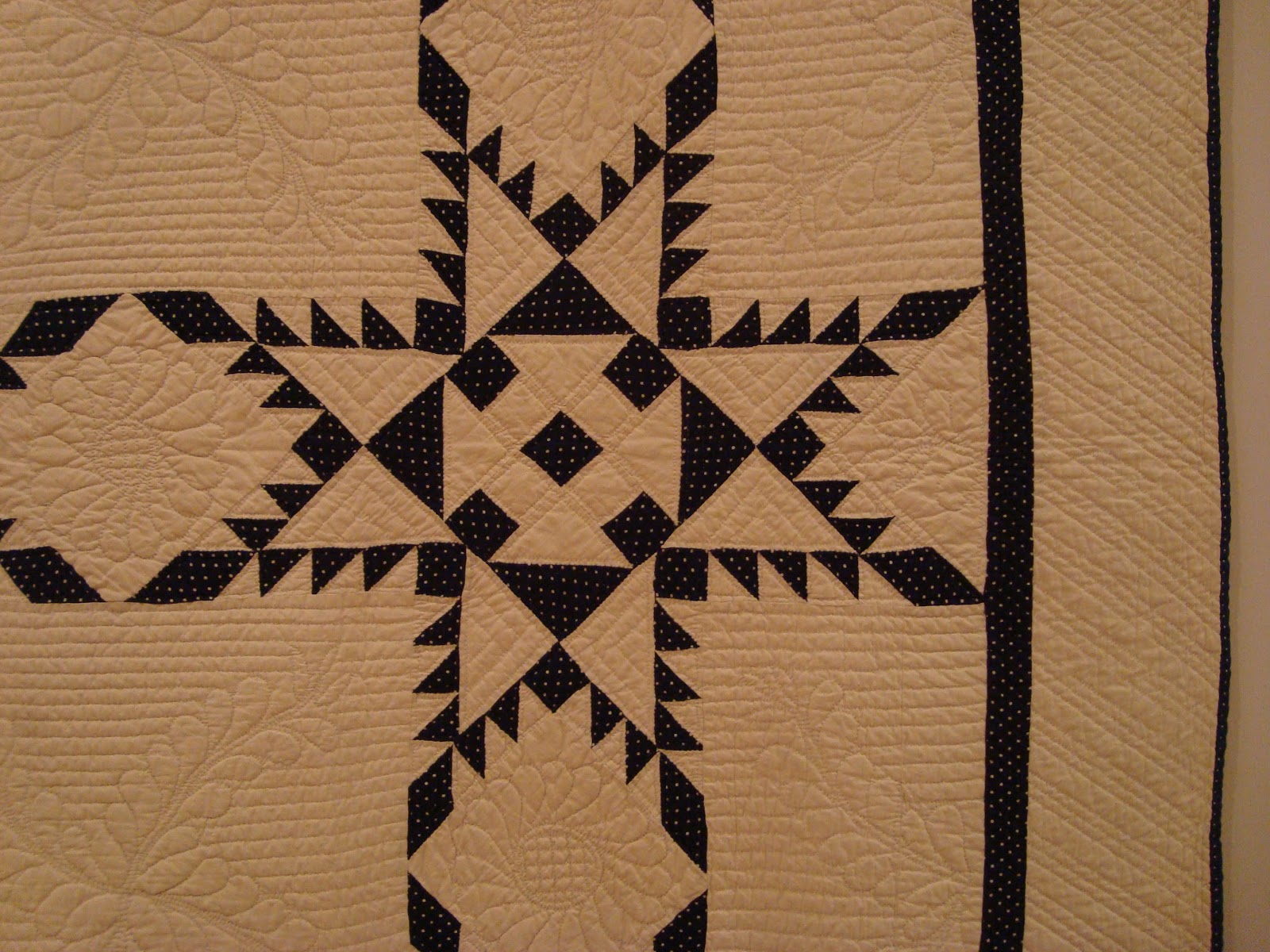
Again, the Feathered Star pattern is reminiscent of a woven coverlet and afforded the quiltmaker, Mary Caroline Robinson Olds of Dekalb County, Indiana, open areas for detailed quilting. The quilt was made for her son Arthur's wedding in 1895.

Star of Bethlehem was another popular pattern for the Revivalists and still is today. The fabrics used in the following quilt made by Christine Heide Sorensen of Rockville, NE were purchased at the J.C. Penney store in Grand Island, NE when the quilt was made in 1928-1930. Christine considered this to be a showpiece quilt done in the bright colors of that era.

Rose designs are always in vogue and this was no exception for the late 1930's. Wreath of Roses may have been purchased as a kit and possibly made in Coshocton County, Ohio between 1935-1945. In the 19th century the quilt would have been created in red and green but here, the updated color scheme gives it a much different look.

Of course the quilting itself is stunning.

Being a lover of applique, Cottage Garden made me stop in my tracks when I rounded the corner and then begged to be studied up close and personal - as much as one can get in a museum.

Quoting from the quilt's placard: "A number of American women made challenging floral medallion quilts, similar to Cottage Garden, during the 1930's and 1940's. These quilts were inspired by a nineteenth-century quilt made in rich reds, blues and pink by Arsinoe Kelsey Bowen in 1857. Bowen's quilt design grew from the heritage of chintz applique bedcoverings and their antecedents-printed and painted Indian palampores.

The above photo is Arsinoe Kelsey Bowen's quilt from Ruth Finley's book "Old Patchwork Quilts and the Women who Made Them", Plate 57 and clearly was the inspiration for "Cottage Garden".
The unknown maker of Cottage Garden preferred the subtler pastel tints of the 1930's and 1940's for her modern masterpiece." And a masterpiece it is.

Notice the blue scallop circling the center medallion that looks like a striped fabric.

No. There are very narrow pieces of fabric wrapped around the blue swags and both edges appliqued. Amazing! Those berries are huge - maybe a bit larger than 1/4" - compared to the berries in the medallion pictured below.

Those berries are about 1/8" with teeny tiny stems. Quite magnificent. In my mind the maker of this quilt was quite inventive with the border design. She could have the look of a scalloped border without having to bind any inside points! The blue border is appliqued on top of the quilt and then bound with straight binding.

Each year Baltimore on the Prairie offers an optional bus trip to the IQSC where participants view the current exhibits, such as the one profiled above and then are treated to a private showing of one of the Baltimore Album quilts in their collection. Once we run out of their Baltimore Album quilts, we may request Cottage Garden! In 2012, Carolyn Ducey, Curator of Collections, met with the group to share her knowledge of the quilt and answer any questions. As we all want to learn more about these exquisite quilts, their makers and the time frame in which they were made, lively discussions abound with everyone sharing their knowledge.
While visiting the exhibits we learned that a new expansion is being planned for the IQSC! The gallery area will be doubled and there will be much more storage space for future acquisitions. For more information about the International Quilt Study Center, including their virtual gallery, visit their web site at http://www.quiltstudy.org/. For more information about the Baltimore on the Prairie applique conference, visit http://www.baltimoreontheprairie.tresajones.com/index.html.
While visiting the exhibits we learned that a new expansion is being planned for the IQSC! The gallery area will be doubled and there will be much more storage space for future acquisitions. For more information about the International Quilt Study Center, including their virtual gallery, visit their web site at http://www.quiltstudy.org/. For more information about the Baltimore on the Prairie applique conference, visit http://www.baltimoreontheprairie.tresajones.com/index.html.
Until next time, take care,
Tresa


